 how-to guide
How to Find Supportive Communities for Personal Growth
Table of Contents
- How to Find Supportive Communities for Personal Growth: A Step-by-Step Approach
- Types of Supportive Communities for Personal Growth
- Benefits of Supportive Communities for Self-Development
- Online Communities for Personal Growth: Platforms and Spaces to Explore
- Vetting Community Safety and Avoiding Toxic Spaces
- How to Build a Supportive Community Around You
- Common Mistakes When Seeking Supportive Communities
- Paid vs. Free Communities: What's Worth Your Investment
Last Updated: July 30, 2026
Finding supportive communities for personal growth can feel overwhelming, but a clear, step-by-step approach makes it manageable. At Soul Perfect, we understand that meaningful community isn't something you stumble into, it's something you deliberately build. Below, we'll show you exactly how to identify the right communities, evaluate their health, and make genuine connections that accelerate your personal development.
Step 1: Define Your Personal Growth Goals and Needs
Get clear on what growth means for you right now. Without clarity, you'll join communities that don't match where you're headed. Write down your specific goals: Are you navigating a major life transition? Building confidence? Developing a new skill? Healing from past experiences?
Consider your preferred learning style and format. Do you thrive in real-time conversation or asynchronous discussion? Do you want expert-led instruction, peer support, or both?
Step 2: Identify the Types of Supportive Communities That Fit You
Understanding the landscape helps you search strategically. Main categories: online forums and digital platforms offer convenience and global reach; in-person workshops provide face-to-face accountability; mastermind groups and accountability partnerships create intensive, structured support; social media communities blend accessibility with varied quality.
Each has trade-offs. Online forums let you lurk before participating but can feel impersonal. In-person groups build stronger bonds but require schedule alignment. Masterminds demand significant time but deliver focused results.
Step 3: Search Across Multiple Platforms and Channels
Your search strategy matters. Start with platforms known for hosting supportive communities: Reddit has thousands of active subreddits by interest; Discord servers range from niche hobbies to structured personal development; Meetup.com aggregates local in-person groups; Facebook groups remain one of the largest community spaces; LinkedIn groups connect professionals; Skool and Circle are platforms built specifically for paid membership communities.
Don't overlook traditional channels: community colleges, libraries, nonprofits, universities, houses of worship, yoga studios, and wellness centers often host relevant groups.
Search using specific keywords tied to your goals. Instead of "personal growth community," search "accountability partners for career change" or "support group for life transitions."
Step 4: Evaluate Community Quality and Culture Before Joining
Spend time observing before committing. Most communities let you browse without joining. Read recent discussions. Do people seem genuinely supportive or dismissive? Are questions answered helpfully or ignored? Does leadership actively moderate?
Look for green flags: clear community guidelines and active moderation; members helping each other without gatekeeping; a mix of newcomers and experienced members; regular activity; responsive leadership.
Red flags deserve serious attention: constant arguing, members attacking each other, absent or defensive leadership, newcomers being dismissed, persistent spam. Ask yourself: Would I feel safe being vulnerable here? Would I trust the advice? If you answer no, keep looking.
Step 5: Make Your First Connection and Introduce Yourself
A thoughtful introduction sets the tone for your whole experience. Include who you are and what brought you here (be specific about your goal), what you're hoping to learn, and a genuine question or request for advice.
Don't try to sound impressive or hide struggles. "I'm terrified of starting over after my divorce and looking for people who've been through this" generates far more support than generic self-improvement talk.
After introducing yourself, engage meaningfully. Respond to others' posts. Ask follow-up questions. Share what you're learning.
Types of Supportive Communities for Personal Growth
Online Forums and Digital Platforms
Online forums remove barriers to entry. You can join from anywhere, anytime. Reddit communities dedicated to specific challenges offer free access to thousands of people working through similar issues. The anonymity helps people be more honest about struggles.
However, Reddit rewards quick, clever responses over thoughtful support. Moderation varies wildly. Spend time in a subreddit before relying on it for serious advice.
Traditional forums on Mighty Networks or Circle offer more curated experiences with clearer moderation, smaller membership, and stronger community culture. Many are paid, creating a self-selecting group genuinely committed to growth.
In-Person Workshops and Group Therapy
Nothing replaces sitting in a room with people facing similar challenges. In-person workshops create accountability through presence. Group therapy, whether formal or peer-led, offers deeper emotional processing. A skilled facilitator creates safety for vulnerability.
The trade-off is logistics and cost. In-person communities require geographic proximity, schedule commitment, and often payment.
Look for in-person communities through local nonprofits, community colleges, therapy offices, and wellness centers.
Mastermind Groups and Accountability Partnerships
A mastermind group is a small collection (typically 4-8 people) who meet regularly to support each other's goals. Each person shares their current challenge, the group offers perspective, and everyone leaves with clear next steps. Masterminds work because of accountability, diverse thinking, and commitment.
Accountability partnerships are simpler: two people commit to regular check-ins about progress. The simple act of reporting to another person dramatically increases follow-through.
Both require finding the right people and establishing clear agreements. The investment is significant, but results are often worth it.
Benefits of Supportive Communities for Self-Development
Building a Stronger Support Network
Isolation is one of the biggest obstacles to personal growth. A supportive community provides perspective, encouragement, and proof that change is possible.
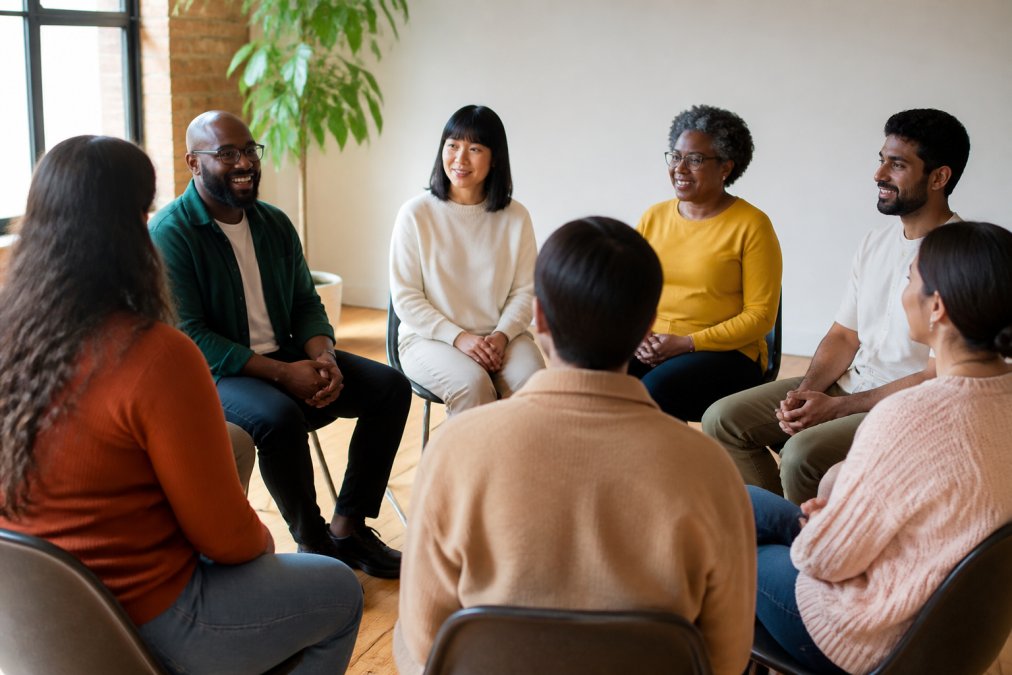
Communities expand your network in lasting ways. You meet people with different skills, experiences, and connections. Some become genuine friends; others become collaborators or mentors. A strong support network also provides practical help, someone might know a therapist you need or have expertise in your field.
Creating Accountability and Sustainable Change
Willpower alone rarely sustains change. Accountability changes this dynamic. When you've told someone about your goal and agreed to check in, you're more likely to follow through even when motivation dips.
Research on habit formation consistently shows people with accountability partners maintain new behaviors longer than those without. Communities structured around accountability create systems that make sustained change more likely.
Finding Belonging and Reducing Isolation
Loneliness is an epidemic, especially during major life transitions. A community of people in similar situations immediately dissolves isolation.
Belonging is essential for mental health and resilience. People with strong community ties recover faster from setbacks, maintain better physical health, and report higher life satisfaction. Meeting someone two years ahead of you who's thriving after facing the same challenge shows recovery is possible.
Online Communities for Personal Growth: Platforms and Spaces to Explore
Social Media Groups and Community Platforms
Facebook Groups remain one of the largest community ecosystems. The advantage is reach; you can find people in your exact situation regardless of geography. When evaluating a Facebook group, check the admin's activity level. Are they responding to questions? Removing spam?
LinkedIn groups serve professionals and career-focused growth. These tend to be higher-quality because members have professional reputations at stake.
Newer platforms like Mighty Networks, Circle, and Skool are built specifically for community. They offer better engagement features and more intentional design. Many are paid, creating higher commitment and often more engaged members.
Niche-Specific Forums and Discussion Boards
Some of the most supportive communities exist on platforms you might not immediately consider. Psychology Today hosts therapist directories and discussion forums. Specific recovery communities like AA, NA, and SMART Recovery have online meetings and forums alongside in-person groups.
Niche forums attract serious, committed people. Someone seeking a forum about healing from narcissistic relationships is likely more serious about growth. These communities often have longer-term members who've made significant progress and can mentor newcomers.
Discord Servers and Real-Time Communities
Discord has evolved into a hub for real-time community. Thousands of Discord servers exist around personal development, mental health, creative pursuits, and professional growth. The appeal is real-time chat, voice channels, and interactive community features.
Discord communities work best with clear structure: designated channels for different topics, regular community events, and active moderation. The real-time nature means you can get immediate feedback, though this can become a crutch if you're avoiding independent processing.
Vetting Community Safety and Avoiding Toxic Spaces
Red Flags That Signal an Unhealthy Community
Watch for communities where one person dominates all discussions. Healthy communities have multiple voices. Beware of communities promising quick fixes or guaranteeing results. Real personal growth is messy and nonlinear.
Notice if the community punishes vulnerability or doubt. Healthy communities hold space for struggle. Check for financial pressure, communities constantly upselling paid programs prioritize profit over wellbeing.
Finally, notice if the community defines itself against an enemy. Groups that constantly blame external forces often breed us-versus-them thinking that limits growth.
Questions to Ask Before Committing
What's the community's philosophy on moderation? Are there clear guidelines? How are conflicts handled?
Who founded this community and why? Understanding the origin story helps assess value alignment.
How long have most members been here? A healthy community has members at various tenure levels.
What does participation look like? Are there expectations to post regularly or attend meetings?
How much does this cost? Be honest about what you can afford.
What happens if I disagree with the community's perspective? A healthy community welcomes respectful disagreement.
How to Build a Supportive Community Around You
Contributing to Community Culture and Engagement
The best communities are built by people who show up, contribute, and care about the group's health.
Participate consistently. Consistency matters more than volume. Celebrate others' wins enthusiastically. Hold space for others' struggles without trying to fix everything. Respect community norms and help enforce them gently.
Transitioning from Online to Offline Connections
Many people start in online communities and want to deepen connections offline. Suggest specific activities rather than vague meetups. Begin with small groups. Be transparent about your intentions. Respect different comfort levels. Consider organizing community events to give others permission to deepen offline connections.
Common Mistakes When Seeking Supportive Communities
Joining too many communities at once. You can't meaningfully participate in five communities simultaneously. Start with one or two.
Expecting communities to solve your problems. Community is a tool for growth, not a substitute for professional help. If you're struggling with depression, anxiety, or trauma, therapy is essential.
Staying in a community that doesn't fit. You don't owe a community your time if it's not serving you.
Lurking without participating. Communities are built on mutual participation. The more you contribute, the more you get back.
Comparing your beginning to someone else's middle. Remember they started where you are.
Expecting immediate results. Give it at least a month of consistent participation before evaluating whether it's working.
Relying on community to the exclusion of other support. You also need professional support, personal practices, and sometimes one-on-one mentorship.
Paid vs. Free Communities: What's Worth Your Investment
Cost isn't the best indicator of quality. Some transformative communities are free. Others charge significant fees and deliver mediocre experiences.
Free communities offer accessibility and low risk. Reddit, Facebook groups, and many Discord servers are free and genuinely helpful. The downside is less moderation, fewer resources, and less structured support.
Paid communities typically offer smaller, curated membership; active leadership and moderation; structured curriculum; and accountability mechanisms. You're paying for curation and structure.
When evaluating a paid community, ask what you're actually paying for. Is it curriculum? Access to experts? Community facilitation? Accountability structure? Make sure cost matches value.
| Community Type | Best For | Time Investment | Cost | Key Benefit |
|---|---|---|---|---|
| Online forums (Reddit, Circle) | Exploration, specific questions | Low | Varies | Accessibility, diverse perspectives |
| Social media groups (Facebook) | Casual connection, broad topics | Low to medium | Free | Ease of joining, large membership |
| Discord servers | Real-time support, niche interests | Medium | Varies | Immediacy, community feel |
| In-person workshops | Skill-building, face-to-face connection | Medium | Varies | Accountability, deeper relationships |
| Mastermind groups | Goal achievement, accountability | High | Varies | Intensive support, results-focused |
| Paid membership communities | Structured growth, expert access | Medium | Varies | Curation, professional facilitation |
| Therapy groups | Emotional healing, professional guidance | Medium | Varies | Clinical expertise, therapeutic structure |
Finding supportive communities for personal growth is one of the most important investments you can make in yourself. The communities you choose shape your beliefs, resilience, and capacity for change. Soul Perfect is built on the belief that meaningful community accelerates growth, that's why we've created a space where members share personal stories, access curated resources, and connect with others on similar journeys. Whether you're exploring online forums, joining a local workshop, or committing to a mastermind group, the communities you choose matter. Choose ones that see you, challenge you, and celebrate you. Your growth depends on it.
Frequently Asked Questions
What are the main benefits of supportive communities for personal growth?
Supportive communities provide accountability, shared learning, and a sense of belonging that accelerates personal transformation. Members gain access to peer support, mentorship, and diverse perspectives that challenge limiting beliefs. Communities also reduce isolation and provide daily encouragement, making sustained self-development more achievable. The social connection itself becomes a growth catalyst, lifelong learners thrive when surrounded by others committed to self-improvement and meaningful change.
Where can I find online communities for personal growth and self-development?
Online communities exist across multiple platforms: Facebook groups and LinkedIn communities for professional growth, Reddit and specialized forums for niche interests, Discord servers for real-time interaction, and dedicated platforms like Skool and Meetup for curated groups. Start by searching your specific interest (e.g., 'mindfulness community' or 'career transition support') plus the platform name. Look for communities with active moderation, clear values, and engaged members. Many growth-focused communities combine multiple platforms to reach different learning styles.
How do I know if a community is actually safe and trustworthy before joining?
Evaluate community culture by observing moderation practices, member behavior, and leadership transparency. Red flags include unchecked negativity, pressure to share personal information, aggressive sales tactics, or lack of clear community guidelines. Before joining, ask: Does leadership respond to concerns? Are members respectful? Is there diversity of thought? Check member reviews or testimonials. Trust your instinct, a nurturing environment should feel welcoming, not pressuring. Many toxic communities hide their culture until you're committed.
Do I need to pay for a supportive community, or are free options sufficient?
Both paid and free communities offer value. Free communities (Reddit, Facebook groups) provide broad access and diverse perspectives but may lack moderation or structure. Paid communities typically offer curated content, accountability structures, mentorship, and a vetted member base, reducing toxicity risk. Your choice depends on your needs: if you need structure and accountability, paid communities often deliver better ROI. If you're exploring or budget-conscious, start free. Many people benefit from combining both, free communities for exploration, paid for deeper transformation.
This article was written using GrandRanker