 how-to
How to Maintain Motivation While Busy: 7 Proven Strategies
Table of Contents
- Why Motivation Fades When You're Busy
- Establish a Morning Routine That Sets Your Tone
- How to Prioritize Tasks When Overwhelmed
- Break Work Into Small Wins and Track Progress
- How to Avoid Burnout When Busy
- Productivity Tips for Busy Professionals
- Schedule Downtime and Fun as Non-Negotiable
- Conclusion
Last Updated: August 15, 2026
Why Motivation Fades When You're Busy
Motivation doesn't disappear because you lack willpower. It fades because busy schedules create a specific problem: your energy gets spread so thin across competing demands that nothing gets your full attention, and nothing delivers the sense of progress that fuels continued effort.
When you're juggling multiple projects, deadlines, and responsibilities, your brain operates in constant context-switching mode. Each shift costs cognitive load. By midday, you've already burned through the mental resources that drive motivation. The work continues, but the spark that makes it feel meaningful gets dimmer with each interruption.
This is different from temporary fatigue. Fatigue is physical tiredness that rest can fix. Psychological burnout is the erosion of motivation itself, where even rest doesn't restore your drive because the underlying problem, feeling overwhelmed and unable to see progress, remains unsolved. When you're busy, you're at high risk for burnout because the conditions that create it are built into your schedule.
The good news: maintaining motivation while busy is entirely possible. It requires a shift in how you approach your workload, not more hours or stronger willpower. The professionals who sustain motivation through heavy workloads share specific practices. They don't work harder; they work differently. They build structure around energy management, create visible progress markers, and protect their mental clarity against the noise.
Below, we'll show you exactly how to maintain motivation while busy by implementing seven proven strategies that address the root causes of motivation loss.
Establish a Morning Routine That Sets Your Tone
How you start your day determines how much mental energy you have available for the rest of it. A consistent morning routine creates a psychological anchor that signals to your brain: this is intentional time, this is within my control.
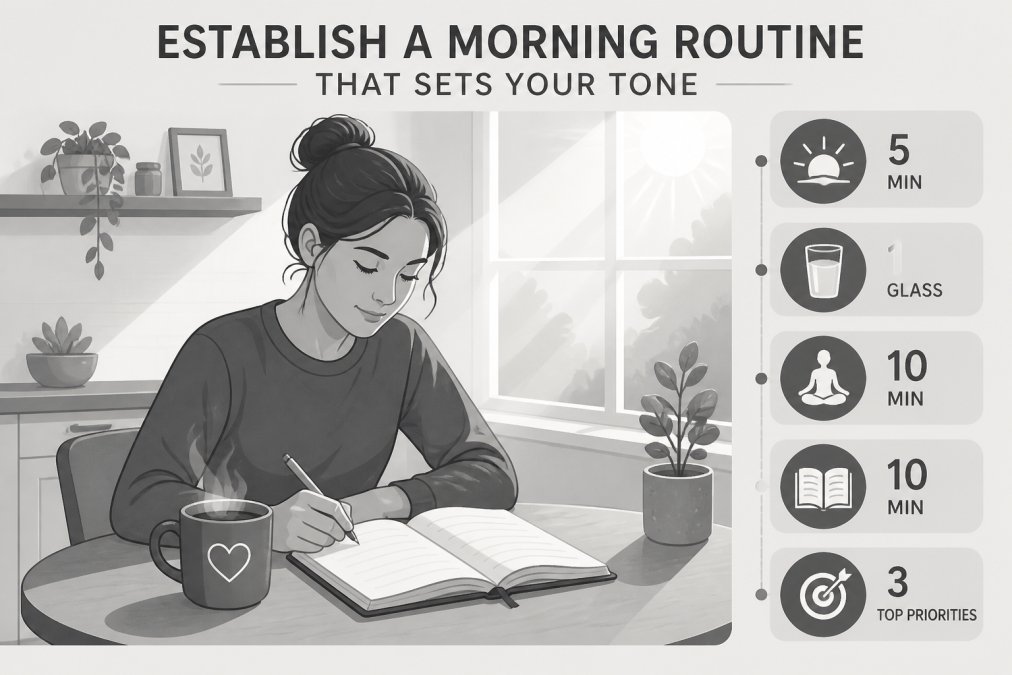
A morning routine doesn't need to be elaborate. It needs to be consistent. The routine itself, whether it's 15 minutes of journaling, a short walk, meditation, or planning your day, matters less than the fact that you're doing something deliberate before the chaos of your workday begins.
Here's why this works: your willpower and mental clarity are highest in the morning. If you spend that peak cognitive capacity on reactive tasks, checking email, responding to messages, jumping into whatever feels urgent, you've already surrendered your best hours to other people's priorities. A morning routine reclaims that time for your own intentions.
A practical morning routine for busy professionals typically includes three components. First, a brief period of physical movement or stillness (5-10 minutes). This could be stretching, a walk, or sitting quietly with coffee. Second, a moment of planning or reflection (5-10 minutes). Write down your three most important tasks for the day or journal about what matters. Third, a transition ritual that signals the shift from personal time to work time. This could be changing clothes, closing the journal, or a specific phrase you say to yourself.
The key is consistency over intensity. A 15-minute routine you do every day builds more resilience than a 60-minute routine you attempt three times a week. Your brain craves predictability, especially when the rest of your day is unpredictable. The routine becomes an anchor that keeps you grounded even when everything else is chaotic.
How to Prioritize Tasks When Overwhelmed
When everything feels urgent, nothing is actually urgent. Prioritization under overwhelm requires a specific framework that removes emotion from the decision.
Start by listing every task competing for your attention. Don't organize it yet, just dump everything out of your head and onto a page or document. This alone reduces cognitive load because your brain no longer has to hold all these threads simultaneously.
Next, apply a simple filter. For each task, ask: Does this move toward my core goal or someone else's? Does this have a real deadline, or does it just feel pressing? Can someone else do this, or does it require my specific skills?
Tasks that move toward your goal, have real deadlines, and require your specific attention go to the top. Everything else either gets delegated, delayed, or deleted. This sounds straightforward, but most people skip this step and instead prioritize based on what feels most urgent or what's causing the most anxiety. That approach guarantees you'll spend your energy on tasks that don't matter.
Once you've identified your actual priorities, protect them. When you're busy, protection means saying no to everything else, at least temporarily. A common mistake is trying to do your priority work while also being available for interruptions. That splits your attention and guarantees mediocre results on both fronts.
Block time on your calendar for priority work. Treat it like a meeting you cannot move. During that time, your other tasks wait. This creates the focus that actually maintains motivation, because you're finally making visible progress on something that matters.
Break Work Into Small Wins and Track Progress
Motivation is directly tied to the perception of progress. When you can see that you're moving forward, you stay engaged. When work feels endless and invisible, motivation collapses.
The solution is to break large projects into smaller milestones and make those milestones visible. Instead of "complete the quarterly report," the milestone becomes "gather data from all departments" (today), "create preliminary analysis" (tomorrow), "draft findings section" (next day). Each smaller step is something you can actually complete, and each completion is a small win.
This works because your brain needs frequent feedback. A project that takes three months to complete doesn't give you any sense of progress for months. Three months of daily small wins, even tiny ones, keeps your motivation engine running.
Track your progress visibly. This could be a checklist you check off, a spreadsheet where you mark completed items, or a simple tally on a whiteboard. The tracking itself becomes motivating because you can see the evidence of what you've accomplished. Many busy professionals skip this step because it feels like extra work, but the psychological boost of visible progress actually saves time by preventing motivation crashes that derail entire projects.
A practical approach: at the end of each day, write down three things you completed. Not three things you attempted or partially did, three things that are actually finished. This creates a daily record of progress that you can review on days when motivation dips. You'll see evidence that you're actually moving forward, even on days that felt unproductive.
How to Avoid Burnout When Busy
Burnout is what happens when you maintain high output without managing energy input. You can work hard for a period of time, but if you never recover, eventually your system collapses.
The prevention strategy is simple in theory but requires discipline in practice: build recovery into your schedule as intentionally as you build in work. This isn't self-care in the Instagram sense, it's energy management.
Energy audits are a practical tool for this. Spend one week tracking not just what you do, but how each activity affects your energy. Some tasks drain you even if they're important. Some activities restore you even if they seem unproductive. The pattern that emerges shows you where you're losing energy unnecessarily and where you need to invest more recovery time.
A common pattern for busy professionals: meetings drain energy far more than focused work does. If your calendar is wall-to-wall meetings, your energy will be depleted regardless of how much sleep you get. The fix isn't more sleep; it's fewer interruptions. Block out meeting-free time. Batch meetings together so you have uninterrupted focus time in between.
Physical health directly impacts your ability to maintain motivation. When you're busy, exercise and nutrition are often the first things to go. This is backwards. These are the things that become more important, not less, when you're under stress. Your body needs movement to process stress hormones and clear mental fog. Your brain needs proper nutrition to sustain focus.
You don't need an elaborate fitness routine. A 20-minute walk, three times a week, significantly improves both energy and resilience. Similarly, basic nutrition, eating regular meals with protein and vegetables rather than skipping meals or relying on caffeine and snacks, stabilizes your energy throughout the day.
The hardest part of avoiding burnout is believing that recovery time is productive. It isn't. It's necessary. There's a difference. Recovery time doesn't move projects forward. It prevents the crash that stops all progress entirely.
Productivity Tips for Busy Professionals
When your schedule is packed, small efficiency changes compound into significant time savings. These aren't about working faster; they're about removing friction from your workflow.
Use Energy Audits to Protect Your Focus
An energy audit is a simple framework: for one week, note what activities energize you and what activities drain you. This isn't about whether tasks are enjoyable, it's about whether they leave you with more or less mental capacity afterward.
After a week, patterns emerge. You'll notice that certain types of work, deep focus time on complex problems, might be mentally demanding but actually energizing because you're making progress. Other activities, like back-to-back meetings with no clear outcomes, drain energy even though they don't require intense focus.
Use these patterns to restructure your week. If meetings drain you, reduce them or batch them. If certain types of work energize you, protect time for more of it. If administrative tasks drain you and don't require your specific skills, delegate or automate them.
This is different from trying to optimize based on general productivity advice. Your energy patterns are individual. What energizes one person exhausts another. The audit reveals your specific pattern, and then you can design your schedule around it.
Build Accountability Into Your Workflow
Accountability is one of the most underutilized motivation tools. When you know someone else is expecting your progress, you're far more likely to follow through.
This doesn't mean reporting to a boss or manager. It means creating a system where your progress is visible to someone who cares about your success. This could be a peer in your field, a mentor, a coach, or a community. A community can create accountability through shared goals and regular check-ins with other members working on similar challenges.
Accountability works because it transforms your commitment from private intention to public declaration. It's easier to skip a goal when only you know about it. It's harder to skip when you know you'll need to explain why to someone else next week.
A practical implementation: find one accountability partner. Once a week, share what you accomplished and what you're working on next. That's it. The regular check-in creates enough social pressure to maintain consistency, and the conversation often surfaces obstacles you hadn't noticed on your own.
Schedule Downtime and Fun as Non-Negotiable
This is the strategy that feels most counterintuitive when you're busy, which is exactly why it's most necessary.

Downtime isn't a reward you earn after you've finished everything. It's a requirement for sustained performance. Without it, your motivation doesn't just fade, it crashes.
Schedule downtime the same way you schedule meetings. Put it on your calendar. Protect it. Don't move it unless there's a genuine emergency. If you wait until you have free time to relax, you'll never relax because there's always more work.
The type of downtime matters less than the consistency. Some people restore through physical activity. Others through quiet time alone. Others through social connection. The key is identifying what actually restores you, not what you think should restore you, and then doing that regularly.
Fun should be scheduled too. When you're busy, spontaneous fun stops happening. You need to plan it. This could be a weekly dinner with friends, a hobby you practice on a specific day, or time spent on something that has nothing to do with productivity. The point is that it's protected time, not something that happens only if you happen to have energy left over.
This sounds like it's about work-life balance, but it's actually about work sustainability. You can work hard for a period of time. But if you never recover, you burn out. Recovery time is what allows you to maintain high output over months and years, not just weeks.
Maintaining motivation while busy isn't about finding more willpower or working longer hours. It's about building structure that protects your energy, creates visible progress, and prevents the psychological burnout that destroys motivation entirely.
The strategies above, morning routines, task prioritization, small wins, energy management, and protected downtime, work together as a system. You don't need to implement all of them at once. Start with one. The morning routine or task prioritization usually creates the fastest visible change. Once that's in place, add the next layer.
Soul Perfect's community platform connects you with others working on the same challenges. Shared accountability, access to resources on intentional living, and regular encouragement from a supportive community make it significantly easier to maintain these practices when life gets hectic. The marketplace offers tools and resources specifically designed to support your motivation and well-being journey.
Frequently Asked Questions
What's the biggest difference between temporary fatigue and psychological burnout?
Temporary fatigue improves with rest and a good night's sleep. Psychological burnout is deeper, it's chronic exhaustion tied to feeling disconnected from your work and losing a sense of purpose. Burnout persists even after time off and requires addressing how you structure your workload and manage energy. Recognizing this difference helps you respond correctly: rest helps fatigue, but burnout needs systemic changes to your routine and priorities.
How can I regain motivation when I feel completely overwhelmed?
Start with one small win. When overwhelmed, your cognitive load is too high. Break your biggest task into the smallest possible next step, something you can finish in 15 minutes. Complete it, acknowledge the progress, then move to the next small piece. This resets your mental state and reminds you that progress is possible. Pair this with a quick walk or 5 minutes of deep breathing to lower stress before tackling the next task.
Can a busy schedule actually improve my focus and motivation?
Yes, when structured correctly. A packed schedule with clear boundaries creates urgency and forces prioritization. However, the key is intentional design: include breaks, protect your most important work for your peak energy hours, and build in accountability. A chaotic, unstructured busy schedule destroys motivation. A well-designed one, where you know what matters most and when you'll do it, actually sharpens focus and sustains motivation because you feel in control.
How do I know if Soul Perfect's community will actually help me stay motivated long-term?
Real change happens when you have both structure and genuine connection. Soul Perfect combines a supportive community with resources and accountability tools. The difference is that you're not just consuming motivation content passively, you're part of a community of people going through similar challenges, sharing real stories, and holding each other accountable. Start by exploring the resources and observing the community. You can lurk without pressure to share until you're ready, and many members find that seeing others' progress reignites their own motivation.
This article was written using GrandRanker