 listicle
Is Mindfulness Meditation Worth Your Time?
Table of Contents
- The Real Time Investment: What Beginners Actually Need
- Science-Based Benefits of Meditation That Actually Matter
- Is Mindfulness Meditation Worth It for Your Schedule?
- Mindfulness Meditation Tools for Consistency
- The Hidden Costs: What Doesn't Get Discussed
- Making the Decision: Is It Worth Starting?
- Frequently Asked Questions
Last Updated: September 19, 2026
The Real Time Investment: What Beginners Actually Need
Is mindfulness meditation worth the time? That's the question most people ask before they start. The answer depends entirely on what you're hoping to get out of it and how much time you actually have available.
The real barrier is committing to practice when your schedule is packed. Beginners can build a meaningful practice in 5-10 minutes daily. Consistency matters more than duration.
Mindfulness meditation works best when it fits your actual life, not the life you wish you had. A 5-minute practice you stick with beats a 30-minute practice you abandon after two weeks.
The real time investment includes setup and habit formation. For most people, 2-4 weeks pass before meditation feels automatic.
Science-Based Benefits of Meditation That Actually Matter
The benefits are real but cumulative. The timeline and minimum dose matter far more than most articles acknowledge.
Stress Reduction and Nervous System Regulation
Meditation activates your parasympathetic nervous system, shifting you out of chronic fight-or-flight.
A single session produces immediate physiological changes, but they fade within hours. Real value comes from consistency.
Measurable nervous system changes emerge around 8 weeks of daily practice. Shorter daily sessions (10-15 minutes) show similar benefits on a slightly longer timeline, around 10-12 weeks.
The minimum effective dose is 10 minutes daily. More than 20 minutes doesn't produce proportionally greater benefits, diminishing returns apply.
Cognitive Function and Mental Clarity
Meditation improves focus by training attention like a muscle, translating directly to work performance and decision-making.
During meditation, you notice when your mind wanders and redirect it hundreds of times per session, strengthening focus in other areas.
Meditation changes brain structure in regions associated with attention and emotional regulation within 8 weeks of daily practice. Intermittent practice requires 12-16 weeks.
A 2019 study found 13 minutes of daily meditation for 8 weeks improved sustained attention and working memory. Five-minute sessions showed minimal cognitive benefit, you need at least 10 minutes daily for measurable improvements.
Sleep Quality and Emotional Regulation
Meditation reduces mental chatter that keeps you awake, helping you fall asleep faster and sleep deeper.
Sleep improvements appear within 2-3 weeks of nightly meditation (10-15 minutes before bed), making it one of the fastest-acting benefits for sleep problems.
Meditation teaches you to observe emotions without being controlled by them, creating space to choose your response instead of reacting immediately.
Benefits emerge around 6-8 weeks of consistent practice. Brief daily meditation (5-10 minutes) shows measurable improvements in emotional reactivity and mood stability by week 8.
The Time-to-Benefit Reality Check
Here's the practical summary for the 'worth the time' question:
- Stress reduction: 10 minutes daily, 8-10 weeks to notice significant change
- Sleep improvement: 10-15 minutes before bed, 2-3 weeks to see results
- Focus and concentration: 10-15 minutes daily, 8 weeks for measurable cognitive improvement
- Emotional regulation: 5-10 minutes daily, 6-8 weeks to notice changes in reactivity
- General anxiety reduction: 10 minutes daily, 4-6 weeks for noticeable improvement
The critical insight: there's a minimum threshold (around 10 minutes daily for most benefits), but there's also a plateau. Going from 10 to 45 minutes daily doesn't produce proportionally greater benefits. The relationship is logarithmic, not linear. This is why consistency matters more than duration, a 10-minute practice you do every day beats a 30-minute practice you do twice a week.
Is Mindfulness Meditation Worth It for Your Schedule?
If you're dealing with chronic stress, anxiety, or sleep problems, meditation is worth the time. Even 10 minutes daily shows measurable improvement within 4 weeks.
If you're seeking a quick mood boost, meditation might disappoint initially. Benefits are cumulative, not immediate.
Can you protect 5-10 minutes daily? That's the minimum for meaningful results. If not, other practices like journaling or movement might fit better.
| Situation | Realistic Time Commitment | Expected Timeline | Worth It? |
|---|---|---|---|
| High stress or anxiety | 10 minutes daily | 2-4 weeks to notice changes | Yes |
| Sleep problems | 10-15 minutes before bed | 3-4 weeks for improvement | Yes |
| General wellness interest | 5 minutes daily | 6-8 weeks to feel benefits | Maybe |
| Very busy schedule (less than 5 min daily) | 3-5 minutes | Minimal results | No |
| No consistent schedule | Irregular | Very unlikely to see benefits | No |
Mindfulness Meditation Tools for Consistency
The gap between starting meditation and maintaining it is where most people fail. Tools help bridge that gap.
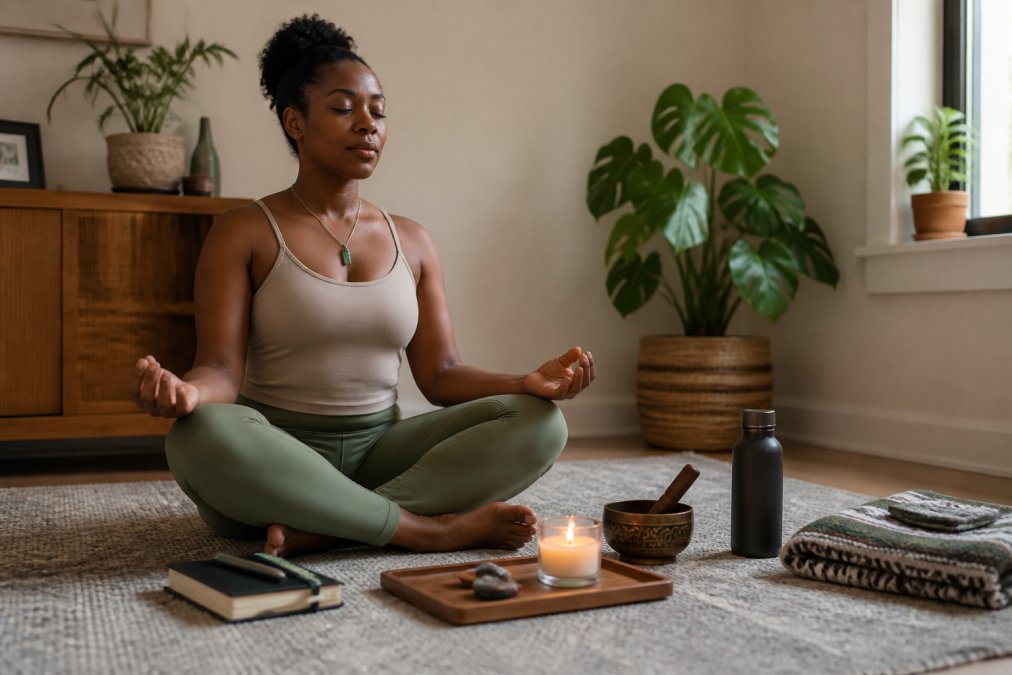
A dedicated space makes consistency easier. A quiet corner, cushion, and minimal distractions help your brain associate the location with meditation.
Candles create a sensory anchor, signaling your brain it's time to meditate. The One Moment at a Time Amber jar soy candle ($21.99) is made with 100% natural soy wax and a cotton wick.
One Moment at a Time Amber jar soy →
Affirmation posters reinforce your intention. The One Moment at a Time Framed poster ($29.99) features a matte black frame and includes hanging hardware.
A journal next to your meditation spot encourages you to note what you observe. You don't need to write much: just a few words about how you felt or what you noticed. This practice deepens self-awareness and creates a record of your progress.
Wearable reminders keep your intention front-of-mind. The One Moment at a Time Unisex Super Heavyweight Hoodie ($54.99) and One Moment at a Time Bubble-free stickers ($5.99) work on water bottles, laptops, or anywhere you need a visual reminder.
Choose one or two tools that resonate with you rather than implementing everything at once.
The Hidden Costs: What Doesn't Get Discussed
Meditation isn't risk-free, though this is rarely discussed. Understanding the downsides helps you make an informed decision.
Meditation-Induced Anxiety and Adverse Effects
For some people, sitting in silence amplifies anxiety. Studies suggest 10-25% of regular meditators experience unwanted effects ranging from mild restlessness to panic attacks or dissociation.
Meditation quiets distractions. For people with unprocessed trauma or anxiety disorders, silence can surface difficult emotions faster than the nervous system can process them.
This is particularly relevant for people with:
- Post-traumatic stress disorder (PTSD) or trauma history
- Panic disorder or generalized anxiety disorder
- Bipolar disorder (meditation can sometimes trigger manic episodes)
- Dissociative disorders
- Psychotic spectrum conditions
If you have these conditions, work with a therapist trained in trauma-informed meditation or use guided practices designed for anxiety to reduce adverse effects.
If you experience increased anxiety, racing thoughts, or panic during meditation, stop and consult a mental health professional before continuing.
The Opportunity Cost Is Real
Five minutes daily equals roughly 30 hours per year. For people with extremely limited time, that trade-off matters.
For most people with chronic stress or sleep problems, meditation is a better use of time than alternatives. But if you already have strong sleep, low stress, and good focus, meditation might not be the highest-ROI use of those hours.
This is why the "Is it worth it?" question depends entirely on your current situation. Someone working 60-hour weeks with insomnia will see a faster return on meditation time than someone with a balanced schedule and no sleep problems.
Meditation as Avoidance
Meditation can become a substitute for actual change. You can meditate daily and still stay in toxic situations. Meditation reduces stress but doesn't fix underlying problems.
Meditation manages your internal state but isn't a substitute for external action. If you're meditating to tolerate harm rather than working toward change, you're undermining your wellbeing.
Ask yourself: Am I using this to manage stress while working toward change, or to avoid necessary changes?
Meditation and Perfectionism
Meditation can become another source of perfectionism and self-judgment. If you miss days or struggle to focus, some people spiral into guilt rather than simply restarting. The practice works best when you approach it with self-compassion, not perfectionism.
Common perfectionist traps in meditation:
- Believing you're "doing it wrong" if your mind wanders (mind-wandering is literally the point of the practice)
- Judging yourself for missing sessions
- Comparing your practice to others' or to an idealized version
- Pushing through discomfort instead of adjusting your approach
- Expecting linear progress instead of accepting that some days are harder than others
The Plateau Effect
After 12-16 weeks of consistent practice, many people hit a plateau where the benefits level off and meditation feels less novel or rewarding. This is normal and doesn't mean the practice has stopped working, it means your nervous system has adapted. However, some people interpret this plateau as a sign that meditation isn't working anymore and quit.
Making the Decision: Is It Worth Starting?
Start meditation if you're willing to commit to 10 minutes daily for at least 4 weeks. That's the minimum threshold for meaningful results. If you can't make that commitment right now, wait until your schedule allows it. A sporadic practice won't deliver the benefits you're hoping for.
Frequently Asked Questions
How long should you meditate for beginners to see real results?
Research suggests beginners can experience measurable benefits with just 5-10 minutes daily. Consistency matters more than duration. Many people notice improved focus and reduced stress within 2-3 weeks of daily practice. As your practice deepens, extending to 15-20 minutes can amplify cognitive and emotional benefits. The key is showing up regularly rather than forcing longer sessions that become unsustainable.
What are the science-based benefits of meditation that are actually proven?
Clinical research confirms meditation reduces cortisol levels, improves emotional regulation, and enhances cognitive function. Studies show consistent practitioners experience better sleep quality, lower anxiety, and improved focus. Neuroplasticity research demonstrates that regular mindfulness practice physically changes brain structure in areas related to attention and self-awareness. These aren't theoretical, they're measurable outcomes documented across peer-reviewed studies.
Is there a downside or 'dark side' to mindfulness meditation?
For most people, meditation is safe, but it's not universally risk-free. Some practitioners report increased anxiety, emotional overwhelm, or dissociation, particularly those with unprocessed trauma. Meditation can amplify difficult emotions before resolving them. If you're managing a mental health condition, consult a qualified professional before starting a formal practice. Meditation works best as a complement to, not a replacement for, professional mental health treatment.
Can mindfulness meditation actually replace traditional stress management techniques?
Meditation is a powerful stress-reduction tool, but it's most effective as part of a broader approach. Traditional techniques like exercise, sleep, social connection, and professional therapy address different aspects of wellbeing. Meditation enhances your capacity to manage stress by improving emotional regulation and self-awareness, but it doesn't replace the physiological benefits of movement or the relational healing of community support. The best results come from combining multiple evidence-based practices.